Processing....

Executive Gov

Digital News Coverage of Government Contracting and Federal Policy Landscape
Sticky Logo
  • Home
  • Acquisition & Procurement
  • Agencies
    • DoD
    • Intelligence
    • DHS
    • Civilian
    • Space
  • Cybersecurity
  • Technology
  • Executives
    • Profiles
    • Announcements
    • Awards
  • News
  • Articles
  • About
  • Wash100
  • Contact Us
    • Advertising
    • Submit your news
    • Jobs
Logo
Artificial Intelligence/Defense And Intelligence/News
DOW, ODNI Seek Proposals for AI Evaluation Harness & Benchmark Framework
by Miles Jamison
Published on March 12, 2026
Department of War seal. DOW seeks proposals for an evaluation harness and benchmarks for artificial intelligence systems.

The Department of War, in coordination with the Office of the Director of National Intelligence, is seeking industry proposals for an evaluation harness and government-defined benchmarks that would enable rigorous, reproducible and vendor-agnostic testing of artificial intelligence systems against criteria specified by the government.

DOW, ODNI Seek Proposals for AI Evaluation Harness & Benchmark Framework

Sign up for the Potomac Officers Club’s 2026 Artificial Intelligence Summit on March 18 to hear Cameron Stanley, chief digital and AI officer at the Department of War, and other federal, defense and industry leaders discuss the impact of AI, machine learning and automation.

Table of Contents

  • What Features Are Required in the Evaluation Harness?
  • What Standards Must the New Benchmarks Meet?
  • Why Is the Government Expanding AI Evaluation Capabilities?

What Features Are Required in the Evaluation Harness?

According to the commercial solutions opening notice published by the Defense Innovation Unit, the War Department is pursuing an evaluation harness that connects to AI models, facilitates evaluation workflows and measures their performance against benchmarks. The harness should support human-in-the-loop, agentic and adversarial evaluations. It should simulate an integrated environment to continuously test and monitor an AI model performance in challenging settings. Furthermore, the harness should generate evaluation reports and manage benchmark execution.

What Standards Must the New Benchmarks Meet?

Vendors must provide methodologies for creating benchmarks across unclassified, secret and top secret workflows that are resistant to gaming, adaptable as requirements and AI models evolve, and supported by training materials. These benchmarks should identify capabilities for particular missions, break those capabilities into measurable tasks and create realistic evaluation scenarios. They should also define clear scoring criteria, establish fair performance baselines using open models and ensure benchmarks are valid, reliable and capable of distinguishing different levels of performance.

Why Is the Government Expanding AI Evaluation Capabilities?

The government is pursuing new evaluation systems to address the rapid advancement of AI technologies. The new infrastructure should be able to evaluate newly released AI models against mission-specific benchmarks. In addition, the system should assess human-machine collaboration to determine whether joint operations yield better mission outcomes than either humans or automated systems alone.

The effort, dubbed “Mystic Depot,” follows calls by Pentagon leadership to accelerate the adoption of AI across warfighting and administrative operations, DefenseScoop reported. Interested vendors can submit their responses to the CSO by March 24.

Artificial Intelligence/DoD/News
DHA Introduces Data & Innovation Strategy to Support Military Health Operations
by Elodie Collins
Published on March 12, 2026
Jesus Caban, chief data and analytics officer at DHA. Caban said the strategy will help the agency address problems sooner

The Defense Health Agency has launched a new Data and Innovation Strategy to improve warfighter readiness by strengthening how the agency manages information across military health operations.

DHA said Wednesday the strategy is designed to give warfighters and military medical leaders faster access to trusted data and support decision-making.

“This strategy will equip DHA leaders to develop interventions and address complex problems sooner and with greater confidence,” Jesus Caban, the agency’s chief data and analytics officer, stated at a recent event. “Ultimately, this translates to a healthier, more decisive, and better-equipped fighting force.”

DHA Introduces Data & Innovation Strategy to Support Military Health Operations

Caban is a panelist at the Potomac Officers Club’s 2026 Artificial Intelligence Summit on March 18. The DHA official will share insights on model orchestration for mission-specific data during the Does Your AI Play Well with Others? panel alongside other military leaders and industry experts. Sign up now to secure your seat.

Table of Contents

  • How Will DHA’s Data and Innovation Strategy Support Military Health?
  • Why Does the Strategy Matter for the Department’s AI-First Push?

How Will DHA’s Data and Innovation Strategy Support Military Health?

According to DHA, the strategy is built around the principle that better data enables better outcomes.

The strategy can enable the agency to provide a real-time view of key combat support resources, including blood inventories, medical bed capacity, expertise and training available through the Joint Trauma System, and the availability of medical personnel for contingency planning.

The strategy also supports data-sharing efforts with the Department of Veterans Affairs. Lisa Rosenmerkel, chief data officer at the VA, said data helps build trust in patient care decisions and improves understanding of patient populations and care modalities.

Why Does the Strategy Matter for the Department’s AI-First Push?

DHA said it is building centralized and authoritative data sources that can serve as a foundation for more advanced analytics and artificial intelligence tools. The effort aligns with the Department of War’s broader push to become an “AI-first” enterprise.

In a January memorandum, War Secretary Pete Hegseth, a two-time Wash100 winner, directed the department to accelerate AI adoption across operations, intelligence and enterprise missions to strengthen military advantage.

Government Technology/News
INL’s MARVEL Microreactor Moves Forward With DOE Safety Approval
by Kristen Smith
Published on March 12, 2026
DOE approved a safety analysis for INL’s MARVEL microreactor.

Idaho National Laboratory’s MARVEL project has reached a pivotal development phase following DOE approval of its safety blueprint, a move that provides a standardized template for the next generation of commercial microreactors.

The Preliminary Documented Safety Analysis, or PDSA, approval allows researchers to advance toward testing of the MARVEL system, short for Microreactor Applications Research Validation and Evaluation, a small-scale nuclear reactor designed to support research, technology demonstrations and industry experimentation.

Table of Contents

  • What Is the MARVEL Microreactor Project?
  • What Does the DOE Safety Approval Enable?
  • Which Teams Are Selected to Conduct MARVEL Experiments?

What Is the MARVEL Microreactor Project?

Developed under the DOE Microreactor Program, MARVEL uses a sodium-potassium coolant and is designed to generate roughly 85 kW to 100 kW of thermal energy and about 20 kW of electricity. Researchers will use the system to study microreactor behavior and evaluate potential applications, including combining the MARVEL reactor with a modular data center and using it to evaluate high-performance sensor systems that could help track the performance of advanced reactors.

MARVEL, expected to be operational by late 2027, will eventually connect to INL’s nuclear microgrid.

What Does the DOE Safety Approval Enable?

The PDSA defines the safety framework for MARVEL’s first experimental configuration. The initial phase will involve a dry criticality test, a controlled, near-zero-power experiment that enables researchers to examine how the reactor core behaves before progressing to higher-power operations.

“This is more than just a regulatory requirement — it’s a blueprint for the future of advanced nuclear,” said Abdalla Abou-Jaoude, MARVEL microreactor lead at INL.

“By receiving approval for our safety documentation, we are now able to share this template with developers to learn from our process and streamline their own timelines,” he added.

The next stage of the program will focus on completing final safety documentation, assembling the reactor system and preparing for fuel loading as the demonstration moves closer to operational testing.

Which Teams Are Selected to Conduct MARVEL Experiments?

INL previously selected five teams — Amazon Web Services; DCX USA and Arizona State University; General Electric Vernova; Radiation Detection Technologies; and Shepherd Power, NOV and ConocoPhillips — to conduct early research projects using the reactor testbed.

News/Space
NASA’s Titan-Bound Dragonfly Rotorcraft Enters Integration, Testing Phase
by Kristen Smith
Published on March 12, 2026
Dragonfly mission identifier. NASA’s Dragonfly mission has moved into the integration and testing phase.

NASA’s Dragonfly mission has reached a new development stage as engineers begin assembling and testing the rotorcraft lander that will explore Saturn’s moon, Titan.

The work is taking place at the Johns Hopkins Applied Physics Laboratory, where teams are integrating major spacecraft components and preparing the system to withstand launch and deep-space conditions, NASA said Tuesday.

Dragonfly is scheduled to launch no earlier than 2028 and will travel for roughly six years before arriving at Titan to conduct a multi-site exploration of the moon’s chemistry, geology and atmosphere.

Table of Contents

  • What Systems Are Being Tested First?
  • How Will Dragonfly Explore Titan?
  • What Happens Next for the Dragonfly Mission?

What Systems Are Being Tested First?

Initial integration activities have focused on verifying the operation of key spacecraft electronics. Engineers recently conducted power and functional tests on the integrated electronics module, which contains the spacecraft’s core avionics, and the power switching units, which regulate the distribution of electrical power, after connecting them to the rotorcraft’s wiring system.

How Will Dragonfly Explore Titan?

Dragonfly is designed as a nuclear-powered rotorcraft roughly the size of a small vehicle. Unlike traditional landers that remain in a single location, Dragonfly will fly between sites on Titan’s surface during its science mission.

The vehicle’s rotors will allow it to travel across Titan’s terrain and investigate multiple geologically interesting regions, including dune fields and impact sites such as Selk Crater.

“Dragonfly isn’t a mission to detect life — it’s a mission to investigate the chemistry that came before biology here on Earth,” said Zibi Turtle, Dragonfly principal investigator and planetary scientist at Johns Hopkins APL. 

What Happens Next for the Dragonfly Mission?

Integration and testing at APL will continue through 2026 and early 2027. Dragonfly will move to Lockheed Martin Space in Colorado later in the process for system-level testing before returning to APL for final environmental testing designed to simulate space conditions.

The rotorcraft is expected to travel to NASA’s Kennedy Space Center in Florida in 2028 to prepare for launch aboard a SpaceX Falcon Heavy rocket.

Dragonfly was selected in 2019 as part of NASA’s New Frontiers program, which funds planetary science missions designed to address major questions about the solar system.

Acquisition & Procurement/Civilian/News
FAA Seeks Industry Input to Enhance National Airspace System Cybersecurity
by Miles Jamison
Published on March 12, 2026
Federal Aviation Administration seal. FAA seekes industry input on the NAS Cyber Information Security and Operations program.

The Federal Aviation Administration has launched a market survey to identify vendors capable of supporting the National Airspace System, or NAS, Cyber Information Security and Operations program.

FAA Seeks Industry Input to Enhance National Airspace System Cybersecurity

FAA cybersecurity efforts to safeguard critical aviation systems underscore the growing need for resilient federal networks. Learn more at the Potomac Officers Club’s 2026 Cyber Summit on May 21, where government and industry leaders will discuss evolving threats and zero trust priorities. Register now!

Table of Contents

  • What Is the Scope of the NAS Cyber Information Security & Operations Effort?
  • Why Is Cybersecurity Critical for FAA?

What Is the Scope of the NAS Cyber Information Security & Operations Effort?

According to a sources sought notice published Wednesday on SAM.gov, the FAA is seeking industry input on potential contractors that can provide penetration testing, risk assessments and vulnerability evaluations for NAS systems. Vendors must be able to conduct cybersecurity testing in lab, simulation and operational environments. They should also evaluate controls for operational technology, industrial control systems, supervisory control and data acquisition systems, telecommunications infrastructure and aviation-specific systems.

In addition, contractors should support regression testing, incident response, tabletop exercises and cybersecurity architecture assessments. The scope also includes assessing system interdependencies and identifying risk and capability gaps.

Work may be performed at contractor and government facilities, including FAA headquarters in Washington, D.C., the Air Traffic Control System Command Center and other operational sites. Responses are due April 10.

Why Is Cybersecurity Critical for FAA?

The FAA requires secure and resilient information systems to ensure safe and efficient air travel. With adversaries ranging from nation-state actors to independent groups targeting government networks, the agency faces threats capable of disrupting or compromising its information environment. Strengthening cybersecurity posture is essential to protect systems, maintain continuity and safeguard the integrity of the National Airspace System.

Cybersecurity/DoD/News
Lt. Gen. Joshua Rudd Confirmed as USCYBERCOM, NSA Leader
by Jane Edwards
Published on March 11, 2026
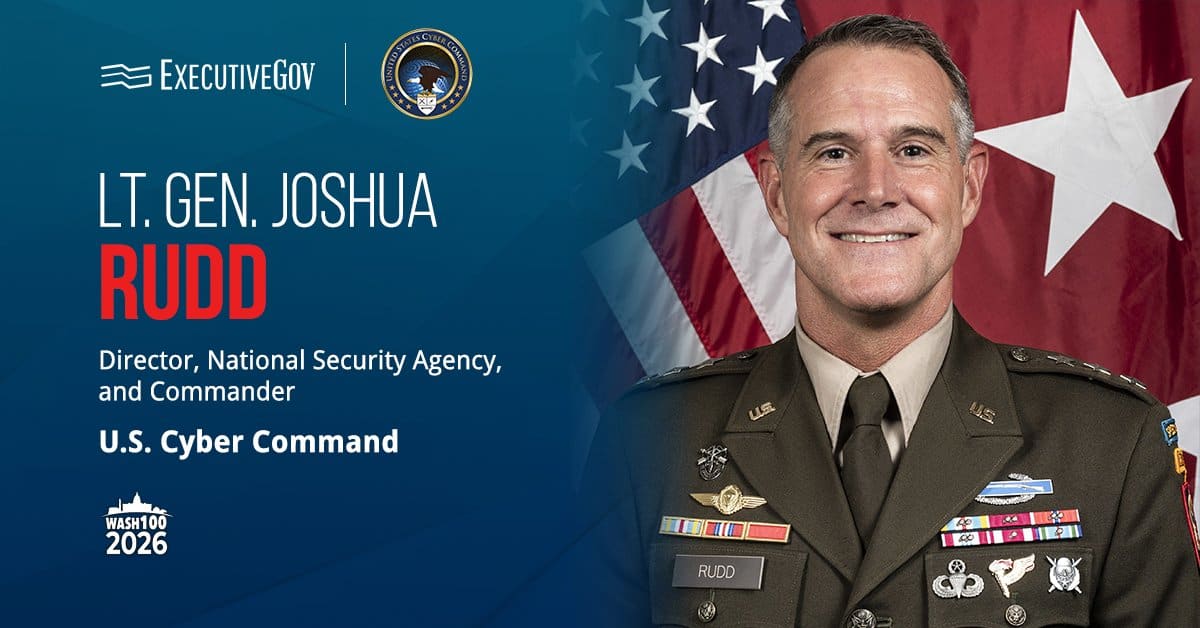
Lt. Gen. Joshua Rudd. The U.S. Indo-Pacific Command deputy commander has been confirmed as head of NSA and USCYBERCOM.

The Senate on Tuesday confirmed Lt. Gen. Joshua Rudd to serve as director of the National Security Agency and commander of U.S. Cyber Command in a 71–29 vote, according to congressional records.

Lt. Gen. Joshua Rudd Confirmed as USCYBERCOM, NSA Leader

The leadership transition at NSA and USCYBERCOM highlights the growing importance of cybersecurity strategy and national defense priorities. As government and industry leaders navigate evolving cyberthreats, forums for collaboration and insight are more critical than ever. Reserve your seat now at the 2026 Cyber Summit to join the conversation.

Following the confirmation, Rudd, a 2026 Wash100 Award winner, will be promoted to general as he assumes leadership of the two organizations.

President Donald Trump nominated Rudd in December to lead USCYBERCOM and NSA in a dual-hatted capacity.

Since April 2025, Lt. Gen. William Hartman has been leading the two organizations in an acting capacity.

Table of Contents

  • Who Is Lt. Gen. Joshua Rudd?
  • What Did Rudd Say About His Cyber Intel Experience & Section 702?

Who Is Lt. Gen. Joshua Rudd?

Rudd most recently served as deputy commander of U.S. Indo-Pacific Command.

He has held several senior leadership roles, including chief of staff at INDOPACOM; commander of Special Operations Command Pacific, where he oversaw special operations forces across much of the Indo-Pacific region; and deputy commanding general for operations of the 25th Infantry Division. 

He supported several combat deployments during his career, including Operation Enduring Freedom, Operation Iraqi Freedom, Operation New Dawn and Operation Inherent Resolve.

The Furman University graduate earned his commission through the Reserve Officers’ Training Corps program, entering active duty as a quartermaster officer.

What Did Rudd Say About His Cyber Intel Experience & Section 702?

During his confirmation hearings, Rudd told lawmakers that his background in interpreting and applying cyber intelligence equips him to lead the two organizations, Nextgov/FCW reported.

“I’m confident that the incredible talent at Cyber Com-NSA will provide great advice,” he told the Senate Armed Services Committee in January, adding that he would work to ensure both organizations continue providing support to combatant commanders across the joint force.

Rudd also addressed Section 702 of the Foreign Intelligence Surveillance Act, a surveillance authority that is set to expire in April. Speaking to the Senate Intelligence Committee, he said the authority provides decision-makers with critical insight into threats and noted that the law has “saved lives here in the homeland,” according to Nextgov/FCW.

Support Lt. Gen. Rudd in the Wash100 popular vote competition now! Your votes could help him become the most popular man in GovCon.

Artificial Intelligence/News
GSA Issues Draft AI Contract Terms
by Jane Edwards
Published on March 11, 2026
General Services Administration logo. GSA issued draft AI contract terms and conditions.

The General Services Administration has proposed new terms and conditions for artificial intelligence systems that would require vendors selling AI technology to the federal government to grant agencies broad usage rights and meet neutrality standards for system outputs.

GSA Issues Draft AI Contract Terms

As federal agencies move to strengthen oversight and procurement rules for AI technologies, conversations about how government acquires and deploys AI continue to gain momentum across the public sector. The 2026 Artificial Intelligence Summit on March 18 will bring together experts to discuss the evolving AI landscape. Register now to save your spot!

The draft guidance from GSA’s Federal Acquisition Service outlines contract provisions for AI models, services and related tools acquired through federal procurement channels. Comments on the draft are due March 20.

The proposal comes as the Trump administration ordered federal agencies to stop using Anthropic’s Claude AI and begin phasing out the technology amid a dispute with the Department of War over restrictions on how the system could be used.

GSA has also terminated Anthropic’s OneGov agreement, with Federal Acquisition Service Commissioner Josh Gruenbaum, a previous Wash100 awardee, saying the move ends the company’s availability to the executive, legislative and judicial branches through GSA’s pre-negotiated contracts, according to a report by Reuters.

Table of Contents

  • What Rights Would the Government Have to Use AI Systems?
  • What Neutrality Requirements Would Apply to AI Outputs?
  • What Are the Other AI Procurement Requirements Proposed in the Draft?

What Rights Would the Government Have to Use AI Systems?

Under the proposal, contractors would grant the U.S. government an irrevocable license to use AI systems delivered under federal contracts.

The license would allow agencies to use the technology for any lawful government purpose, preventing vendors from imposing contractual or technical restrictions on legitimate federal use. The provision is designed to ensure agencies retain flexibility to deploy AI capabilities across missions and programs once the government acquires the technology.

What Neutrality Requirements Would Apply to AI Outputs?

The proposed terms also establish neutrality requirements governing how AI systems generate outputs for federal agencies.

Contractors must ensure their systems do not intentionally encode partisan or ideological judgments in AI-generated outputs and that the systems produce objective responses when used in government contexts, according to the draft guidance.

What Are the Other AI Procurement Requirements Proposed in the Draft?

The proposal also outlines transparency and disclosure requirements for AI vendors seeking federal contracts. Contractors would need to disclose information about model training methods, system limitations and whether models were modified to comply with non-U.S. regulatory frameworks.

The draft also calls for safeguards to protect government data and limits vendors’ use of federal data for model training without authorization, part of GSA’s effort to strengthen oversight of AI technologies used across federal agencies.

Civilian/Executive Moves/News
Mangala Kuppa Named Permanent CIO at Department of Labor
by Miles Jamison
Published on March 11, 2026
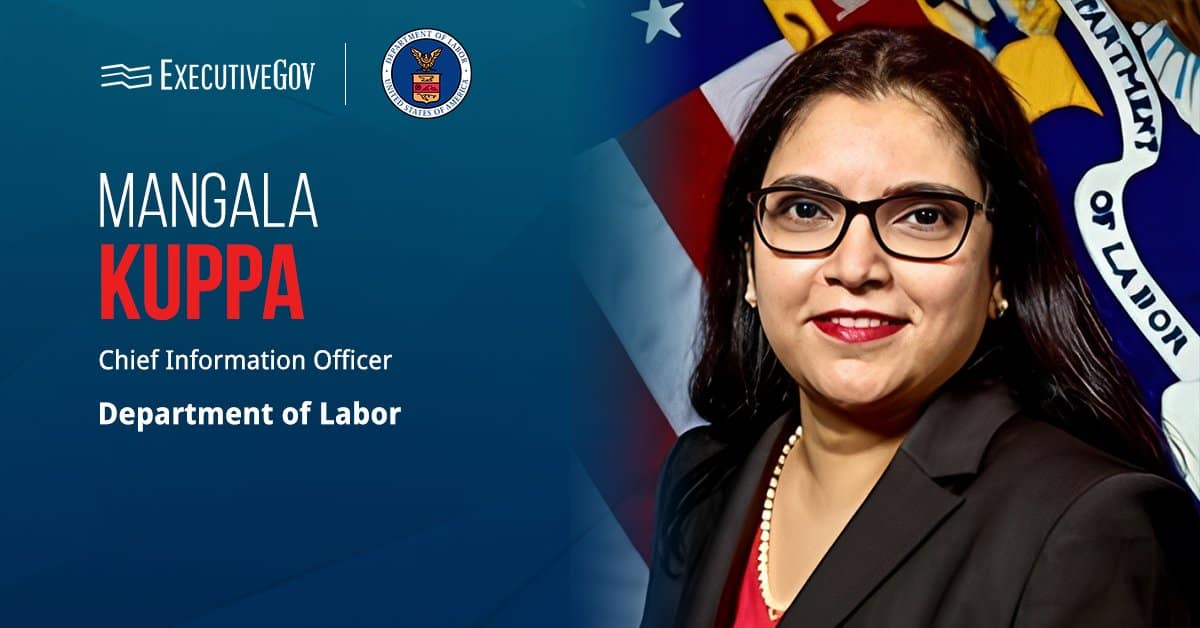
Labor Department CIO Mangala Kuppa. Mangala Kuppa has been appointed chief information officer at the Department of Labor.

Mangala Kuppa announced on LinkedIn Monday that she has been appointed chief information officer of the Department of Labor.

Table of Contents

  • Who Is Mangala Kuppa?
  • What Roles Has Mangala Kuppa Held in Her Career?

Who Is Mangala Kuppa?

Kuppa is a technology leader with over 25 years of experience across the public and private sectors. She is known for leading complex technology initiatives, modernizing IT environments and aligning technology strategies with organizational goals. Her work has strengthened digital capabilities, enhanced cybersecurity resilience and advanced the adoption of emerging technologies in government.

We recently recognized Kuppa as one of the nation’s leading technology professionals advancing strategies that help government agencies adopt and effectively implement AI.

What Roles Has Mangala Kuppa Held in Her Career?

She joined the Department of Labor in 2010 and has since held a series of senior leadership roles within the agency. She most recently served as acting chief information officer and chief artificial intelligence officer. Earlier, she held positions as chief technology officer, director of business application services and director of case management, contributing to several key technology and modernization initiatives across the department.

Before joining the Department of Labor, Kuppa spent more than a decade at the Bureau of Labor Statistics, where she held several leadership roles, including acting director, division chief and project manager. Earlier in her career, she worked in the private sector for nearly 15 years.

Defense And Intelligence/DoD/Government Technology/News
DARPA Launches New QBI Solicitation to Evaluate Utility-Scale Quantum Computing Concepts
by Elodie Collins
Published on March 11, 2026
Defense Advanced Research Projects Agency logo. DARPA has issued a new Quantum Benchmarking Initiative RFP

The Defense Advanced Research Projects Agency is expanding its Quantum Benchmarking Initiative, or QBI, with a new request for proposals to identify and evaluate emerging approaches to building utility-scale quantum computers. 

The agency said Tuesday that it will select companies to participate in a new Stage A Quantum Benchmarking Initiative Topic, or QBIT, where they will describe and prove the feasibility of their full system concept.

Abstracts are due July 31, while full proposals are due Sept. 30. 

DARPA Launches New QBI Solicitation to Evaluate Utility-Scale Quantum Computing Concepts

Learn more about advances in quantum computing and the cyber risks that come with the technology at the Potomac Officers Club’s 2026 Cyber Summit on May 21. Industry, government and defense leaders, including Sarah Muccio from the Air Force Research Laboratory, will participate in panel discussions throughout the day. Get your tickets here.

Table of Contents

  • What Is DARPA’s Quantum Benchmarking Initiative?
  • Who Is Micah Stoutimore?

What Is DARPA’s Quantum Benchmarking Initiative?

DARPA launched QBI in 2024 to determine whether any quantum computing architecture can reach utility-scale operation by 2033.

It uses a multi-stage framework to evaluate potential quantum computing systems. In Stage A, a government test and evaluation team will review participants’ approaches to building a utility-scale quantum computer. Successful participants move to Stage B, where teams refine research and development plans and address risks.

The final stage will focus on verification and validation to determine whether the proposed systems can be built and operated as designed.

DARPA said it has evaluated quantum computing approaches from more than 20 companies since the program launched. In November, the agency announced the 11 organizations advancing to Stage B, including IBM and IonQ.

Micah Stoutimore, who recently assumed the role of managing director of the QIB, said DARPA is expanding participation in the initiative to ensure the agency evaluates every viable pathway toward building a utility-scale quantum computer.

“Both QBI and the broader quantum computing field have advanced rapidly since our first call,” he stated. “In fact, it now seems likely that someone will build a utility-scale quantum computer by 2033, but it remains unclear exactly which team or teams might get across that finish line. We want to ensure we are assessing every viable pathway.”

Who Is Micah Stoutimore?

Stoutimore succeeds Joe Altepeter, who served as the founding program manager of the QBI. The leadership transition is part of DARPA’s limited tenure policy for program leadership.

Stoutimore previously served as deputy program manager for QBI. In the role, he helped shape the program’s evaluation framework and early pilot efforts. Before joining DARPA, he worked as a scientific consultant supporting defense research programs. Earlier in his career, he worked as a scientist specializing in superconducting technologies at Northrop Grumman.

DoD/Government Technology/News
JIATF-401 Adopts Standard Testing Guidelines for Counter-Drone Tech
by Kristen Smith
Published on March 11, 2026
Unmanned aircraft systems. JIATF-401 adopted standardized testing guidelines for counter-drone technologies.

The U.S. Army-led Joint Interagency Task Force 401 has adopted the The Standard Guidelines for Test and Evaluation of Counter-Unmanned Aircraft Systems Technologies, establishing common evaluation criteria for counter-drone capabilities across the Department of War.

The framework requires that all counter-small UAS technology evaluations capture the same core performance data, enabling the department to build a consistent body of evidence to support future development, procurement and operational decisions, the DOW said Tuesday.

Table of Contents

  • Why Are Standard Evaluation Guidelines Needed for Counter-UAS?
  • How Does This Fit Into Broader Counter-Drone Efforts?

Why Are Standard Evaluation Guidelines Needed for Counter-UAS?

Counter-UAS programs currently generate large volumes of test data across different organizations, but the absence of common standards can leave information fragmented or difficult to compare.

Hostile drones pose a growing threat to U.S. forces through intelligence, surveillance and reconnaissance missions and direct kinetic attacks. As commercial drone platforms become faster, smaller and more capable, detecting and defeating them has become increasingly complex. Through common evaluation standards, the task force seeks to deliver adaptable, interoperable C-sUAS capabilities to address the evolving threat.

“The JIATF’s one measure of effectiveness is to quickly deliver state of the art C-sUAS capabilities into the hands of warfighters,” said Brig. Gen. Matt Ross, director of JIATF-401. “Achieving this outcome requires more than innovation; it demands a disciplined approach to testing, evaluation, and continuous improvement.”

The new framework establishes a common terminology for testing counter-drone technologies. According to DOW, the guidelines are intended to streamline testing and fielding processes, guide industry research toward priority capabilities and reduce redundant testing efforts. The initiative also seeks to strengthen coordination across the joint force and interagency partners while increasing operator confidence in the technologies deployed to counter small unmanned aircraft threats.

How Does This Fit Into Broader Counter-Drone Efforts?

The testing guidelines support broader initiatives led by JIATF-401 to accelerate the development and deployment of counter-drone capabilities.

The task force recently released a guide outlining technologies used to detect drone threats, including radar, electro-optical and infrared sensors, acoustic detection systems and radio-frequency monitoring tools designed to track unmanned aircraft while complying with federal privacy laws.

JIATF-401 has also reached initial operational capability for its Counter-UAS Marketplace, an online procurement platform that allows government users to identify and acquire validated drone defense technologies through an existing contract vehicle.

Previous 1 … 10 11 12 13 14 … 2,704 Next
News Briefing
I'm Interested In:
Wash100 Vote Now
Recent Posts
  • NOAA Seeks Proposals for Commercial Microwave Sounder Data Under CDP Program
  • Army’s 3rd Group Converts MICO Into Multidomain Operations Company
  • DOW Partners With Boeing, Lockheed to Boost PAC-3 Seeker Production
  • NRC Selects Matt Pociask as General Counsel, Michael Franovich as Research Director
About

ExecutiveGov, published by Executive Mosaic, is a site dedicated to the news and headlines in the federal government. ExecutiveGov serves as a news source for the hot topics and issues facing federal government departments and agencies such as Gov 2.0, cybersecurity policy, health IT, green IT and national security. We also aim to spotlight various federal government employees and interview key government executives whose impact resonates beyond their agency.

Read More >>

RSS ExecutiveBiz
  • AI Sovereignty Is Key to National Security, Says AMD Global AI Leader
  • Redhorse Secures DOW Acquisition Digitization Prototype OTA
  • RTX BBN Unveils Tool for Covert Network Validation
  • Vantor to Provide NGA With Orbital Intelligence Under New Luno B Contract
  • Oracle Launches Unified AI Data Platform to Accelerate Federal Mission Outcomes
  • Nava Appoints Kelly Feeney as VP of Operations & Automation
RSS GovConWire
  • SpaceX Awarded $178.5M Space Systems Command Task Order for SDA-4 Launches
  • Tanium’s Melissa Bischoping: Agentic AI Could Help Strengthen Federal Network Resilience
  • Boeing Secures $900M Air Force Contract for T-38 Avionics Support
  • Paul Tierney Returns to Dataminr as Head of Public Sector
  • Godspeed Capital Invests in GALT Aerospace to Meet JADC2 Tech Demands
  • USSOCOM Issues $2.7B RFP for SOF Global Services Delivery Contract
Executive Gov

Copyright © 2025
Executive Mosaic
All Rights Reserved

  • Executive Mosaic
  • GovCon Wire
  • ExecutiveBiz
  • GovCon Exec Magazine
  • POC
  • Home
  • Acquisition & Procurement
  • Agencies
    • DoD
    • Intelligence
    • DHS
    • Civilian
    • Space
  • Cybersecurity
  • Technology
  • Executives
    • Profiles
    • Announcements
    • Awards
  • News
  • Articles
  • About
  • Wash100
  • Contact Us
    • Advertising
    • Submit your news
    • Jobs
Go toTop