Executive Gov
  • Home
  • Acquisition & Procurement
  • Agencies
    • DoD
    • Intelligence
    • DHS
    • Civilian
    • Space
  • Cybersecurity
  • Technology
  • Awards
  • News
  • About
  • Wash100
  • Contact Us
    • Advertising
    • Submit your news
No Result
View All Result
Executive Gov
  • Home
  • Acquisition & Procurement
  • Agencies
    • DoD
    • Intelligence
    • DHS
    • Civilian
    • Space
  • Cybersecurity
  • Technology
  • Awards
  • News
  • About
  • Wash100
  • Contact Us
    • Advertising
    • Submit your news
No Result
View All Result
Executive Gov
No Result
View All Result
Home Articles

FAR Compliance: What You Need to Know Before Delivering Goods to the Government

by Kaye Howard
June 6, 2024
in Articles
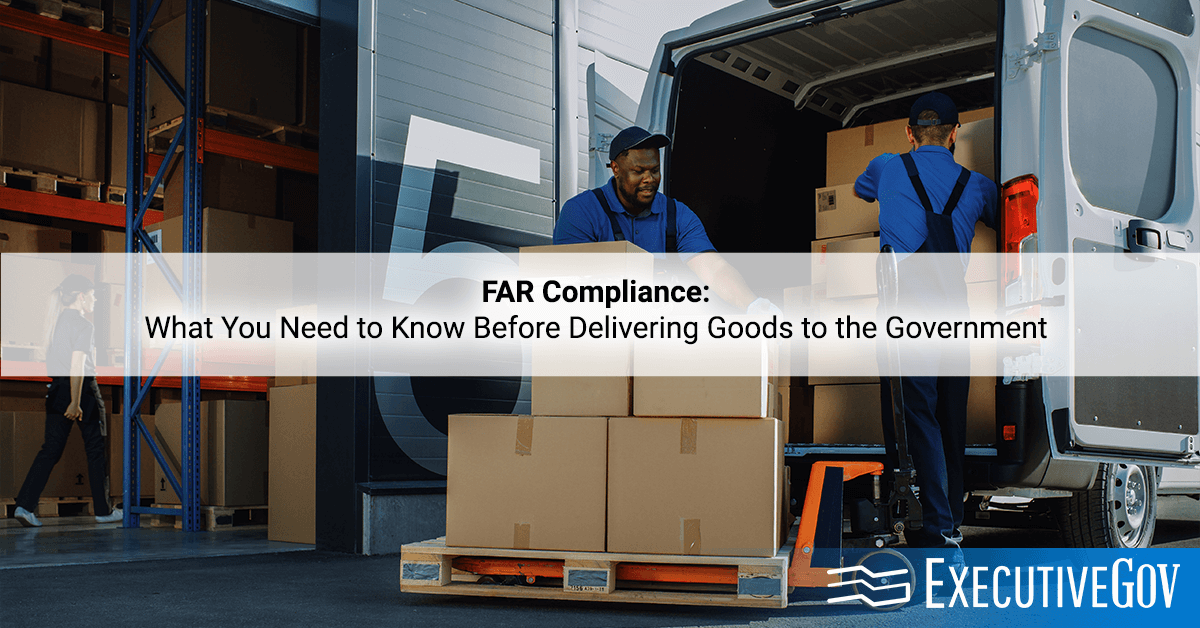
FAR Compliance: What You Need to Know Before Delivering Goods to the Government over an image of two men unloading boxes from a truck

Photo by Gorodenkoff / Shutterstock

FAR compliance is crucial for government contractors to maintain their ties with the federal government. Complying with these regulations allows companies to establish their trades, deliver goods and services and maintain honest and transparent transactions. 

Table of Contents

    • You might also like
    • 5 Ways US Navy Technology Is Racing Ahead
    • Genesis Mission’s Unique Contracting Model Spurs Industry Contributions
    • Air Force Col. John Ohlund Seeking a Few Good Contractors for AI Data Tagging
  • What is FAR?
  • FAR Compliance Components: Where to Start?
    • FAR Part 31 – Contract Cost Principles and Procedures
    • FAR Part 52 – Solicitation Provisions and Contract Clauses
    • FAR Part 15 – Contracting by Negotiation
    • FAR Part 17 – Special Contracting Methods
    • FAR Part 19 – Small Business Programs
    • FAR Part 36 – Construction and Architect-Engineer Contracts
    • Other Components to Consider
  • Frequently Asked Questions
    • What Are the Different Types of FAR Contracts?
    • Does FAR Apply to All Government Agencies?
    • What is DFARS?

You might also like

5 Ways US Navy Technology Is Racing Ahead

Genesis Mission’s Unique Contracting Model Spurs Industry Contributions

Air Force Col. John Ohlund Seeking a Few Good Contractors for AI Data Tagging

If you’re looking to provide services and solutions to the government, read on to learn more about FAR compliance.


What is FAR?

Book with Federal Acquisition Regulation title
Photo by Yuriy K/ Shutterstock

The Federal Acquisition Regulation (FAR) is the primary set of regulations encompassing all government procurement aspects of executive agencies. It was formed through the Office of Federal Procurement Policy Act of 1974, which created a standard for acquiring goods and services for federal agencies in the executive branch.

FAR ensures the delivery of top-caliber products and services while maintaining public trust and fulfilling public policy objectives.

As stated in section 1.102, the main goals of FAR are to:

(1) Satisfy the customer in terms of cost, quality and timeliness of the delivered product or service by, for example –

(i) Maximizing the use of commercial products and commercial services

(ii) Contracting with companies who have a track record of successful past performance or who have demonstrated the ability to perform

(iii) Promoting competition

(2) Minimize administrative operating costs

(3) Conduct business with integrity, fairness and openness

(4) Fulfill public policy objectives

Simply put, FAR compliance is a manual that government contractors must follow to deliver goods and services to federal agencies. It outlines what contractors can and can not charge in a federal contract. 


FAR Compliance Components: Where to Start?

Government contractors having a meeting
Photo by Ground Picture/ Shutterstock

Reading and understanding all eight subchapters and 53 parts of the FAR can be daunting, but there’s a handful of components that fledgling contractors can begin with. 

Outlined below are the key parts to help you get started in FAR compliance:


FAR Part 31 – Contract Cost Principles and Procedures

FAR Part 31 defines the procedures and principles involving contracting costs, such as establishing reasonableness, determining allocability and accounting for unallowable costs.


FAR Part 52 – Solicitation Provisions and Contract Clauses

FAR Part 52 covers the clauses and provisions on allowable costs and payments, including:

  • Reimbursement
  • Direct labor
  • Invoicing
  • Travel expenses
  • Bill payments
  • Warranties
  • Termination
  • Supplies and services
  • Indirect expenses


FAR Part 15 – Contracting by Negotiation

FAR Part 15 establishes the policies and processes for contract negotiations. It guides agencies in preparing proposals and contracts.

At the same time, it gives contractors an estimate of how long a contract negotiation takes to determine the final costs and pricing. It can help contractors gauge their submissions to agencies accordingly.


FAR Part 17 – Special Contracting Methods

FAR Part 17 encompasses specialized contracting arrangements, such as options, leader company and multi-year contracting. Multi-year contracts aim to lower costs, ensure production continuity, stabilize contractor workforces and reduce the administrative burden of contracts.

Moreover, FAR Part 17 clarifies the multi-year agreement requirements for the DoD, NASA and the Coast Guard, including:

  • Substantial cost savings
  • Unchanged procurement needs
  • Stable supply designs
  • Reasonable funding expectations
  • Realistic cost estimates


FAR Part 19 – Small Business Programs

FAR Part 19 covers many elements related to small businesses, including participation through HUBZone, service-disabled veteran-owned, women-owned small businesses (WOSB) and economically disadvantaged women-owned small businesses (EDWOSB).

Additionally, section 19.202-1 promotes the involvement of small businesses in acquisitions and ensures equal opportunity to compete for federal contracts. 


FAR Part 36 – Construction and Architect-Engineer Contracts

FAR Part 36 delves into the contracting procedures and policies for construction and architect-engineer services. It sheds light on standard form requirements and clauses for demolition, dismantling or removal of improvements.


Other Components to Consider

Besides the six essential FAR components, contractors also need to consider provisions for labor standards, intellectual property rights and other clauses.

Here are other FAR clauses to consider:


Termination for Convenience

This clause allows the government to end a contract at any time for any reason. While it gives the government flexibility in its procurement process, it poses a risk for contractors if they’ve already invested time and resources into fulfilling the contract’s orders.


Changes

Under this provision, the government is allowed to change the contract’s terms and conditions. That said, contractors must be prepared to adapt to these adjustments, whether small or drastic, to fulfill their end of the agreement.


Disputes

This clause defines the protocols for resolving disagreements between the government and contractor. It’s designed to promote fairness and transparency in the contracting process.


Small Business Subcontracting

Under this clause, large contractors are required to include smaller businesses in their subcontracting plan. It promotes small business participation in the government contracting process.


The Davis-Bacon Act

The Davis-Bacon and Related Acts oversee prevailing wages, regulations and standards that federal agencies must observe. This provision protects workers from being underpaid and prevents contractors from gaining an unfair advantage.


Frequently Asked Questions


What Are the Different Types of FAR Contracts?

The six types of contracts governed by the Federal Acquisition Regulation are:

  • Fixed-price
  • Cost-reimbursement
  • Incentive
  • Indefinite-delivery (requirements, definite-quantity and indefinite-quantity)
  • Agreements (basic and basic ordering)
  • Time-and-materials, labor-hour and letter


Does FAR Apply to All Government Agencies?

No, it doesn’t. FAR only applies to contracts awarded by agencies within the executive branch, such as the DOD, DOJ and VA.

Contracts from the legislative and judicial branches are subject to separate regulations.


What is DFARS?

FAR and DFARS may look and sound familiar, but they differ greatly in how they’re used. 

Any contracting entity working on a federal contract is subject to FAR compliance. Meanwhile,  only entities working with Controlled Unclassified Information (CUI) must comply with the Defense Federal Acquisition Regulation Supplement.

Additionally, DFARS is a supplement to FAR; contractors must still comply with FAR when working on contracts from the DoD.


You might also want to read: Beginner’s Guide to Becoming a Government Contractor

Stay connected via Google News
Follow us for the latest travel updates and guides.
Add as preferred source on Google
Share5Tweet19
Previous Post

Denise Oberndorf, Others on Army-Wide Capabilities Protection Initiative’s Role in Protecting Financial Data

Next Post

CDAO, Defense Innovation Unit Partner to Accelerate AI, Digital Tech Adoption; Radha Plumb Quoted

Recommended For You

Peter Muend: Director at the National Reconnaissance Office, is a Panelist for the 2024 Space Summit

by Skyler Bernards
October 15, 2024
Peter Muend at the 2024 Space Summit

Peter Muend is the Director of the National Reconnaissance Office's Commercial Systems Program Office. He directs the agency's integration of multiple commercial imagery sources. Peter Muend is one...

Read moreDetails

Boeing Intelligence and Analytics Leadership and Executives Team

by Rachel Ann Chua
July 7, 2023

Boeing Intelligence and Analytics (BI&A), a pioneering force in aerospace leadership and innovation, leverages a pool of exceptional talent and expertise. As they spearhead operations, BI&A remains at...

Read moreDetails

What Are the Top SAIC Government Contracts?

by Kyle Bernal
September 25, 2025
What Are the Top SAIC Government Contracts? Federal Government contracts of Science Applications International Corp

Shutterstock / Photo Contributor: DCStockPhotography Science Applications International Corporation (SAIC) is an American IT services provider helping its customers modernize, integrate, and train across cyber, land, air, space,...

Read moreDetails

Top 10 Government Contracting News Sources

by Cielo Cinco
October 7, 2024
Top 10 Government Contracting News Sources

Federal government contracting is a highly-competitive industry. In the last fiscal year, 2021, the U.S. spent $629 billion on government contracts alone, and it is projected to rise...

Read moreDetails

Schuyler Moore: The Road to Innovation of USCENTCOM’s First-Ever Chief Technology Officer

by Steffan Lyson
October 15, 2024
Schuyler Moore: The Road to Innovation of USCENTCOM's First-Ever Chief Technology Officer

Schuyler Moore drives the innovation culture of the United States Central Command (USCENTCOM) as its first-ever Chief Technology Officer (CTO). Since coming into office in October 2022, she...

Read moreDetails
Sign Up For Our Newsletter
Subscribe to our mailing list to receives daily updates direct to your inbox!
Invalid email address
Your privacy is guranteed.
Thanks for subscribing!

Sponsors

About ExecutiveGov

ExecutiveGov, published by Executive Mosaic, is a site dedicated to the news and headlines in the federal government. ExecutiveGov serves as a news source for the hot topics and issues facing federal government departments and agencies such as Gov 2.0, cybersecurity policy, health IT, green IT and national security. We also aim to spotlight various federal government employees and interview key government executives whose impact resonates beyond their agency.

CATEGORIES

  • Acquisition & Procurement
  • Announcements
  • Articles
  • Artificial Intelligence
  • Awards
  • Big Data & Analytics News
  • C4ISR
  • Civilian
  • Cloud
  • Contract Awards
  • Cybersecurity
  • Defense And Intelligence
  • Defense Security Cooperation
  • DHS
  • Digital Assets
  • Digital Modernization
  • DoD
  • Events
  • Executive Moves
  • Executive Spotlights
  • Federal Civilian
  • Financial Reports
  • Foreign Military Sales
  • General News
  • GovCon Expert
  • Government Cloud
  • Government Technology
  • GSA
  • Healthcare IT
  • Industry News
  • Intelligence
  • Legislation
  • M&A Activity
  • National Security
  • News
  • Policy Updates
  • Press Releases
  • Profiles
  • Space
  • Videos
  • Wash100
Sign Up For Our Newsletter
Subscribe to our mailing list to receives daily updates direct to your inbox!
Invalid email address
Your privacy is guranteed.
Thanks for subscribing!

Copyright 2026 Executive Mosaic. All Rights Reserved. Site Archive

No Result
View All Result
  • Home
  • Acquisition & Procurement
  • Agencies
    • DoD
    • Intelligence
    • DHS
    • Civilian
    • Space
  • Cybersecurity
  • Technology
  • Awards
  • News
  • About
  • Wash100
  • Contact Us
    • Advertising
    • Submit your news

Copyright 2026 Executive Mosaic. All Rights Reserved. Site Archive

Get your free GovCon news!

Get your latest GovCon news and insights. Become a VIP and subscribe to the GovConWire Daily News.

Invalid email address
We promise not to spam you. You can unsubscribe at any time.
Thanks for subscribing!