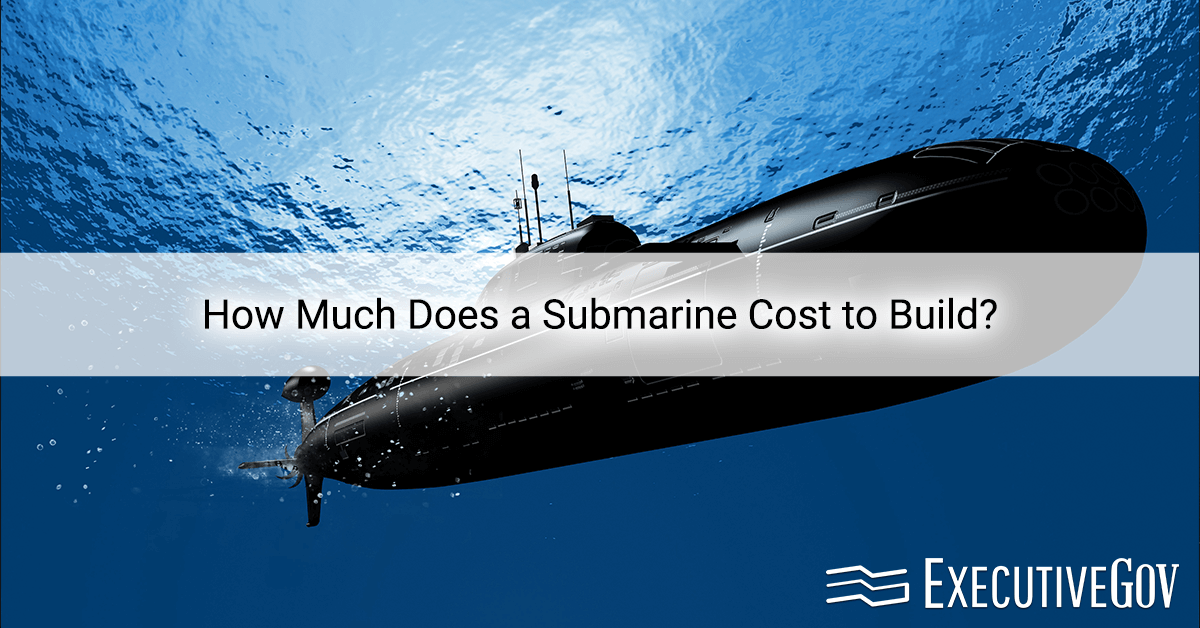
How much does a submarine cost to build? This question zeroes in on governments’ substantial investment in naval defense.
Submarines are critical for national defense, offering stealth and strategic advantages to protect maritime interests. Submarine cost construction, however, is a pricey expenditure, accounting for a considerable portion of the military budget.
Keep reading to learn more about the US Navy submarine costs, types, and classes.
Types of US Submarines
The United States military has many submarines in its defense arsenal, which can be categorized into various types and classes. Here are the three major types of submarines in the US Navy.
Ballistic Missile Submarines (SSBNs)
The Navy’s ballistic missile submarines, or “boomers,” are built to carry nuclear submarine-launched ballistic missiles (SLBMs). They are the sea-based leg of the US nuclear triad, along with air-based strategic bombers and land-based nuclear missiles.
Ballistic missile submarines have noise reduction and survivability features, making them one of the stealthiest vessels in the US Navy inventory.
Attack Submarines (SSNs)
Attack submarines (SSNs) are advanced vessels that the US Navy uses for peacetime and wartime missions. They are equipped with advanced sonar and quiet propulsion systems for detecting enemy vessels and launching cruise missiles for precision targets on land.
SSNs’ stealth capabilities are ideal for deployment in gathering intelligence, collecting data, and monitoring enemy activities while remaining undetected underwater.
Cruise Missile Submarines (SSGNs)
Similar to other attack submarines, cruise missile submarines (SSGNs) are used for tactical missions. However, compared to typical attack submarines, they are designed to carry and launch larger quantities of cruise missiles.
SSGNs’ inherent stealth and tremendous payload capacity make them adaptable in various military missions. In addition, they operate with a dual crew deployment concept, allowing them to remain underwater for extended periods.
US Submarine Classes
US submarines are classified into several groups depending on their design characteristics, construction, and capabilities. Here are some notable classes of US submarines.
Los Angeles Class

The Los Angeles class, also called the 688 class, comprises a range of nuclear-powered fast-attack submarines. Since their kickoff in the 1970s, these submarines have undergone continuous upgrades.
The Los Angeles class submarines are created with capabilities for anti-submarine warfare, intelligence gathering, strike missions, and special operations support. One of their notable features is their nuclear propulsion systems, which enable operations for extended periods without needing to resurface or refuel.
Vessels under the Los Angeles class include:
- USS Columbia (SSN 771)
- USS Tucson (SSN 770)
- USS Hampton (SSN 767)
- USS Charlotte (SSN 766)
- USS Springfield (SSN 761)
- USS Jefferson City (SSN 759)
- USS Asheville (SSN 758)
- USS Alexandria (SSN 757)
- USS Topeka (SSN 754)
- USS Oklahoma City (SSN 723)
- USS Key West (SSN 722)
- USS Chicago (SSN 721)
- USS Pittsburgh (SSN 720)
Seawolf Class

The Seawolf-class submarines were intended to be a more advanced successor to the Los Angeles class. The US Navy initiated the design efforts for these underwater warships in 1983. However, despite the ambitious plans, only three submarines of this class were eventually constructed, namely:
- USS Jimmy Carter (SSN 23)
- USS Connecticut (SSN 22)
- USS Seawolf (SSN 21)
Virginia Class

Virginia-class submarines are the latest additions to the US Navy’s fleet of advanced capability nuclear-powered fast attack submarines (SSN).
Equipped with a fly-by-wire ship control system, SSNs can handle littoral operations. Having a reconfigurable torpedo room, these submarines can also house special operations forces, including all their equipment, for prolonged deployments and future off-board payloads.
Virginia-class submarines that are currently in service are:
- USS San Francisco (SSN 810)
- USS Vermont (SSN 792)
- USS Illinois (SSN 786)
- USS Mississippi (SSN 782)
- USS Missouri (SSN 780)
- USS North Carolina (SSN 777)
- USS Hawaii (SSN 776)
- USS Virginia (SSN 774)
How Much Does a Submarine Cost To Build?
Generally, the average advanced military submarine cost lies between $2.8 billion and $5.5 billion. These figures may vary based on several factors. Put simply, submarines are among the most expensive investments within the armed forces.
Nuclear-powered ballistic missile submarines are the priciest military submarines, with a price range of $10-$20 billion. Nuclear-powered attack submarines come in at a slightly lower cost, typically ranging from $2-$5 billion. Conventional submarines are comparatively less expensive, costing anywhere from $500 million to $800 million.
Among the specific submarine classes, the Los Angeles-class submarines are the most economical at $1.91 billion. On the other hand, Seawolf-class submarines are the most expensive at $5.64 billion, followed by Virginia-class submarines at $3.83 billion, and then Ohio-class submarines at $3.64 billion.
Factors Affecting Submarine Cost

Listed below are the factors that affect submarine cost build.
Design and Technology
The overall submarine cost is mostly linked to its design and technology. Incorporating state-of-the-art features such as advanced sensors, stealth capabilities, and communication systems increases both development and production expenses.
For instance, nuclear-powered submarines generally have higher upfront costs than conventional diesel-electric submarines due to their sophisticated propulsion systems and complex engineering.
Size and Materials
Submarine cost variations can be attributed to size differences and material costs. Larger submarines require more materials and resources, leading to higher construction expenses. Moreover, the choice of materials, such as high-strength steel or advanced composites, also affects both the initial and long-term costs.
Labor and Production Expenses
Labor and production costs are key factors influencing the total submarine expenditures. The intricacy of the production process, including precision welding and quality control measures, affects the total submarine construction cost.
Building a submarine requires skilled labor, engineering expertise, and specialized facilities, which all add up to the overall build expenses.
Are Submarines Worth the Investment?
Investing in submarines is reasonable, given their role in strengthening national security and maritime operational warfare. While submarine acquisition and maintenance come with a hefty price tag, the long-term benefits outweigh these expenses.
Nevertheless, the government must carefully consider the implications of submarine investment on defense budgets. The government must balance finalizing submarine procurement and addressing other defense needs as financial resources are limited.